.png)

Genetics: The Blueprints of Life
- Saanvi Khurana
- May 18, 2024
- 3 min read

By Shreshta Kotha
Introduction
Nails, hair, skin. Almost every physical characteristic contained by individuals is mapped out by scientific instructions known as DNA. Deoxyribose-nucleic acid is an often underrated player in the field of science. This nucleic acid –however overshadowed— is both powerful and complex. With four nitrogenous bases, ribose sugar, and a phosphate group. With adenine, guanine, cytosine and thymine. These words might be taking you back to your favorite science classes. Although we have all dreaded those long lectures that seem to go on for hours and hours, it’s vital to realize the reality and practicality of the genetics field in real life.
World-altering technologies like CRISPR and some of the most meticulous disorders of all like cancer— almost all of the good and bad can be attributed to genetics and DNA specifically. So, yes, DNA may seem like a boring subject in a high school lecture, but it goes much deeper than that. There are so many careers, conditions, and historical revolutions all revolving around this seemingly simple nucleic acid.

So what can genetics be defined as? According to the National Human Genome Research Institute, genetics can be defined as the study of genes and how they play a role in hereditary traits and conditions. On the other hand, genomes are related to the study of the specific interactions between an individual’s genetics and the environment to determine how certain conditions or disorders can be impacted by the results of these interactions. Let’s dive deeper into discovering how genetics and genomes are seen in everyday life. If you’re a person who likes the sound of these topics, keep reading :)
.......................................................................................................................................................
Career Pathways
Here is a list of all the different types of careers a degree pertaining to genetics can be applied to:
Biomedical Engineer
Clinical Laboratory Geneticist
Biocurator
Bioethicist (In fact, a degree in genetics can be applied for law enforcement careers)
Genetics Counselors
Nutritionist
Oncologist
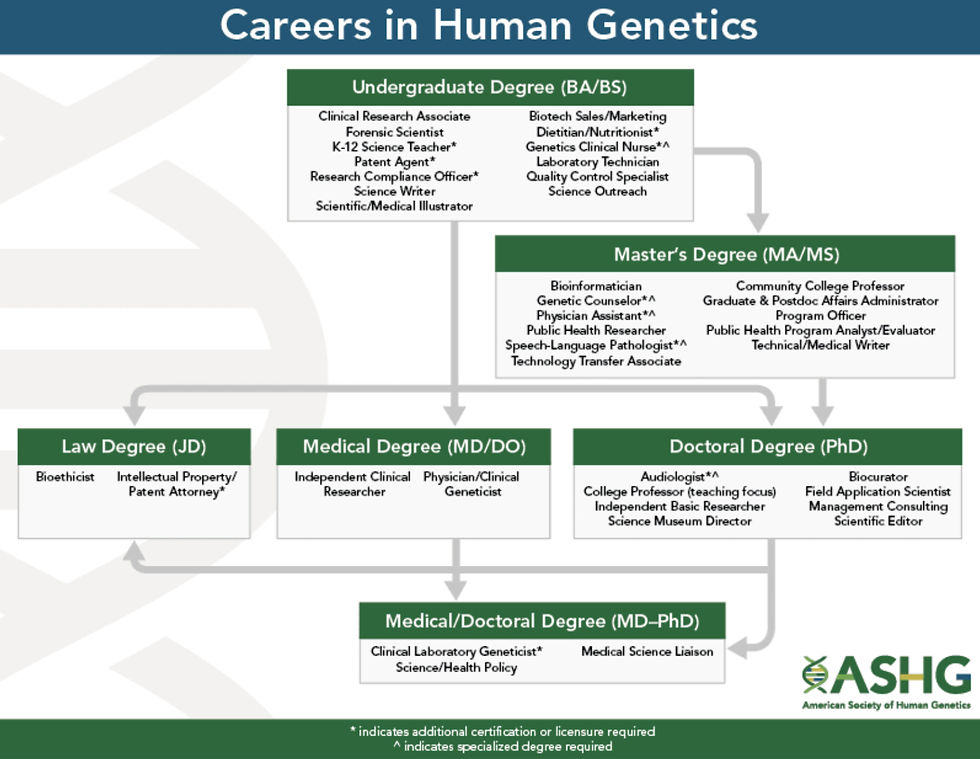
Here is an image that accurately describes different levels of education achieved in genetics and some of the careers offered at these levels. ⬆️
.......................................................................................................................................................
Diseases and Conditions
With a variety of career options available, it is expected that genetics involves a multitude of different conditions to be treated as well. Here is a very brief overview of a small percentage of conditions that are related to the field of genetics (most of these affect chromosomal structures):
Down Syndrome
Coronary Artery Disease
All types of Cancer
Diabetes
Cystic Fibrosis
Muscular Dystrophy
Sickle Cell Disease
To read more information about each condition visit this link: https://my.clevelandclinic.org/health/diseases/21751-genetic-disorders
Reflecting on the Past and Understanding the Future
All the way from Gregor Mendel to CRISPR-Cas9 Software, the field of genetics has come a long way. Identifying the basic laws of inheritance, how genetic allele frequencies are passed down generations, and the meiotic and mitotic processes can all be categorized as Mendelian genetics. However, the father of genetics was incorrect about some aspects and this contributed to the creation of Non-Mendelian genetics. Over time, 1800 disease-causing genes have been identified and 2000 genetic tests have been available.
But what does this mean for the future? What can all of these new technologies and identifications do for the medical community? Well, there is no one answer. With technologies like CRISPR-Cas9 and knowledge about disease-causing genes, the most treacherous genetic disorders like Cancer and Down Syndrome can be eliminated from the population in years to come. This can help reduce the numerous casualties attributed to this field. The medical community is close to finding the key to the cure for genetic disorders.
.......................................................................................................................................................
References
Careers in Human Genetics. (n.d.). ASHG. Retrieved May 18, 2024, from https://www.ashg.org/careers-learning/career-flowchart/
Evolution of genetic techniques: past, present, and beyond. (n.d.). PubMed. Retrieved May 18, 2024, from https://pubmed.ncbi.nlm.nih.gov/25874212/
Genetic Disorders: What Are They, Types, Symptoms & Causes. (n.d.). Cleveland Clinic. Retrieved May 18, 2024, from https://my.clevelandclinic.org/health/diseases/21751-genetic-disorders
Genetics vs. Genomics Fact Sheet. (2018, September 7). National Human Genome Research Institute. Retrieved May 18, 2024, from https://www.genome.gov/about-genomics/fact-sheets/Genetics-vs-Genomics
.......................................................................................................................................................


Comments